
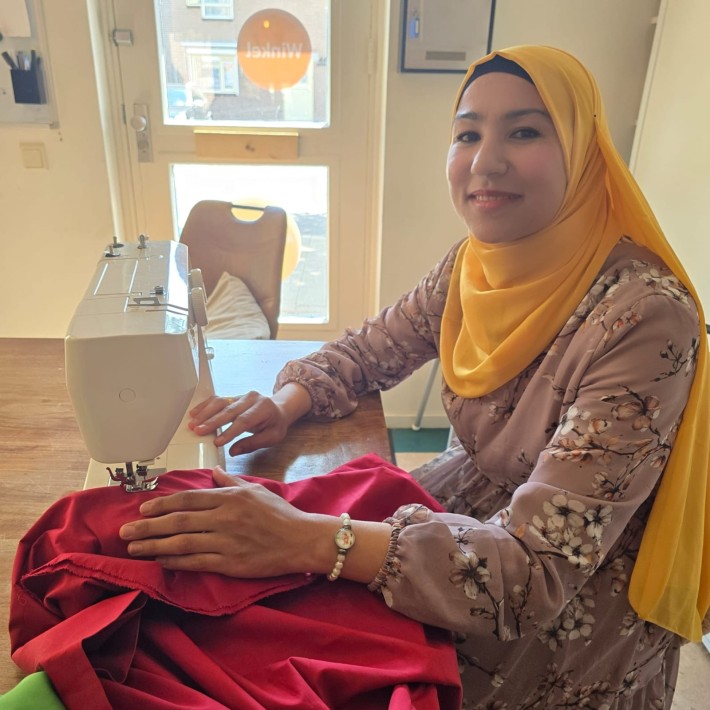
Volunteering as a meeting place
Pregnant with her first child, Khadija, now 29, fled the war in Syria. She lived in a tent camp in Turkey for five years and went on to have three more children. In 2023, she found a safe haven in Lelystad. Through her voluntary work, she is learning the language and getting to know other people.
But oh, this new language is so difficult to get to grips with. ‘I do understand what’s being said, but I find it hard to reply. Because I feel embarrassed if I use a word incorrectly. I think it’s really important to get it right, so I think long and hard before I say anything.’
Her three eldest children don’t, though; they speak Dutch fluently. ‘They talk so fast that I can’t keep up,’ she says with a laugh.
Through volunteering, Khadija meets other people and practises the language a lot. At De Brink community centre, for example, where she volunteers to mend clothes. ‘I’ve already got to know loads of people. I’m always quick to give out my phone number, so we can help each other out.’
She also helps out a lot at her children’s school. ‘It feels as if I’m back at school myself. I missed that back in my own country.’
Volunteering and integration
When Khadija arrived in Lelystad in 2023 after fleeing her home country, she immediately began the integration programme. This consists of 800 hours of lessons and 800 hours of work experience, for example through volunteering.
Her dream? She is cautious in her reply, as she never attended school in her own country. ‘In the Netherlands, you need a qualification for almost everything, so it’s going to be difficult. But I don’t mind what it is, as long as I can earn my own money.’
In the meantime, she continues with her integration classes and her voluntary work. From her own experiences, she knows how difficult it can be to build a life in a new country. That is why she also helps other newcomers.
For example, she helped four newcomers find their feet at the De Waterbever community centre in the Waterwijk neighbourhood. She also gives practical money advice to women in the same situation. ‘If you’ve lived in a tent camp and you go to the supermarket here with your children, they’ll want everything. And you’re tempted to give it to them, because you can.’
But in reality, it isn’t always financially feasible. ‘In that case, I go with them to the supermarket and explain what the special offers are. It’s better to pay your fixed bills first and then spread the remaining amount over four weeks. That way, you’ll manage to make your money last.’
At home in Lelystad
Lelystad is her home and that of her family. ‘I notice that my children are still in awe. We simply have our own house and they have their own rooms. When they see the images on TV of the tent camps, they ask if we’re really staying here. I certainly hope so.’
Syrian refugees are granted a five-year residence permit, after which a decision is made on whether to extend it. ‘Yes, I’m worried. Syria might seem safe, but it isn’t. If I have to go back, I won’t have a home there anymore. How could I ever go back?’